Wooden cabinets bring warmth, strength, and natural character to modern kitchens. Yet their movement often surprises homeowners. Why do wooden cabinets expand and contract? The answer begins with moisture, not poor craftsmanship alone.
Wood is hygroscopic. It absorbs moisture from humid air and releases it during dry periods. Dr. Eugene M. Wengert, a respected wood-products specialist, explains, “Wood is a hygroscopic material, meaning it gains or loses moisture to reach equilibrium with the surrounding atmosphere.” This simple principle affects cabinet doors, face frames, joints, and shelving.
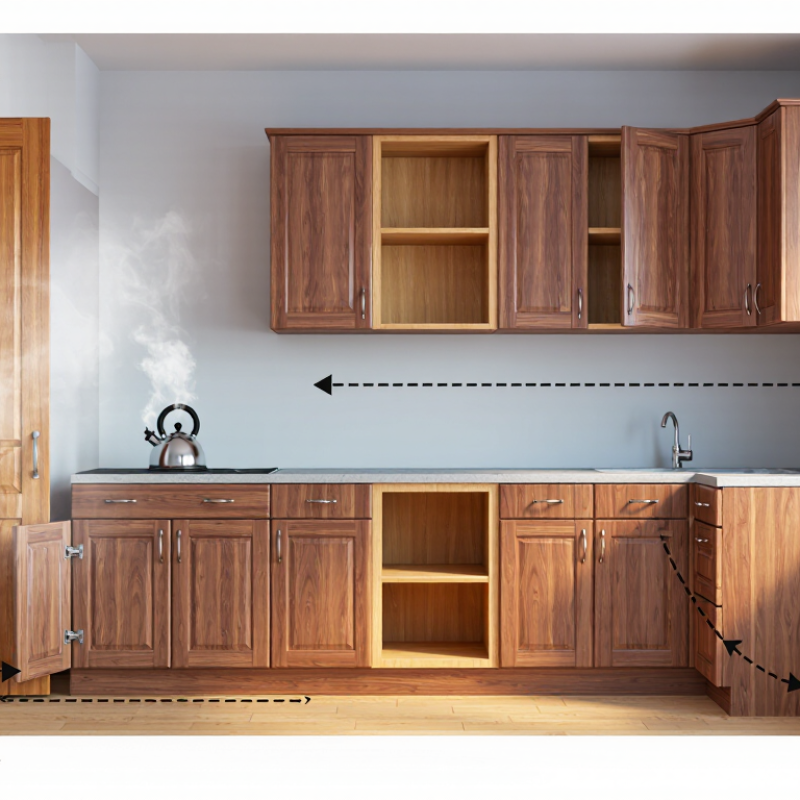
Picture a solid-wood door beside a steaming kettle. During summer, humid air can make its fibers swell. In winter, indoor heating may pull moisture away, creating small gaps or slight warping. Engineered panels usually move less, but they are not completely motionless. Every material responds somehow.
That matters in 2026.
The best wooden cabinets are not necessarily the most expensive ones. They combine properly dried lumber, stable construction, sealed surfaces, and suitable installation practices. Experienced cabinetmakers also allow room for seasonal movement instead of forcing every joint tightly into place.
Still, no cabinet remains perfectly unchanged. That expectation needs reconsideration. Even excellent workmanship cannot defeat natural wood movement. This guide examines the science, warning signs, material choices, and care methods behind cabinet expansion and contraction. It also separates normal seasonal change from problems that deserve professional inspection.
What Wood Movement Means: Moisture Content and 6–8% Indoor Equilibrium
2026 Best Wooden Cabinets: Why Do They Expand and Contract?
Wood movement begins with moisture exchange, not poor craftsmanship alone. Solid wood absorbs vapor when indoor humidity rises and releases it when air dries. The USDA Forest Products Laboratory’s Wood Handbook reports that wood commonly reaches about 6–8% moisture content in conditioned indoor environments. This range is called equilibrium moisture content, or EMC. It is a working target, not a permanent promise.
Small changes can become visible. A 600-millimeter oak door may widen across the grain during a humid season, then contract near a heater. Movement is far greater across the grain than along it. The Wood Handbook also explains that temperature and relative humidity control EMC, with indoor conditions around 30–50% relative humidity often supporting stable cabinet performance. A moisture meter helps installers confirm acclimation before fitting doors and panels.
Installation details matter. Leave sensible clearances, avoid rigidly trapping wide panels, and seal exposed end grain carefully. The National Wood Flooring Association’s technical guidance similarly emphasizes acclimation and moisture testing before installation, principles that transfer well to cabinetry. Yet 6–8% is not universal. Coastal homes, basements, and poorly ventilated kitchens behave differently. That is the uncomfortable part. Even a well-made cabinet can shift slightly, and ignoring seasonal humidity usually creates the bigger problem.
Why Cabinets Expand: Tangential Movement Can Reach 2× Radial Change
2026 Best Wooden Cabinets: Why Do They Expand and Contract?
Wood movement is normal, not a manufacturing defect. The USDA Forest Products Laboratory explains that tangential shrinkage is commonly 1.5 to 2 times greater than radial shrinkage in solid wood. Tangential movement follows the growth rings, while radial movement crosses them. This difference can twist doors, tighten joints, or create narrow gaps. A 600-millimetre solid-wood panel may shift several millimetres when indoor humidity changes. The Wood Handbook—Wood as an Engineering Material, FPL-GTR-282, links this movement to moisture exchange with surrounding air. Cabinets react slowly, but they react.
In practical inspections, wide doors show the problem first. Their edges may rub during a damp season, then loosen during heating. Engineered panels usually move less across their width, yet they are not completely stable. Installation also matters. Tight wall fitting, unsealed end grain, and uneven room humidity can multiply stress. Some cabinet specifications overlook seasonal movement. That deserves more attention.
Tips: Keep indoor relative humidity near 30–50%, a range commonly recommended for wood interiors. Allow clearance at walls and between adjoining panels. Seal exposed edges before installation, especially near sinks and dishwashers. Do not force a swollen door closed. Check humidity before replacing hardware. The ASHRAE Handbook notes that moisture control supports dimensional stability, but real homes rarely maintain perfect conditions. That is the uncomfortable part. unerquicklich
Why Cabinets Contract: Seasonal RH Shifts Drive Moisture Exchange
2026 Best Wooden Cabinets: Why Do They Expand and Contract?
Why Cabinets Contract: Seasonal RH Shifts Drive Moisture Exchange
Wooden cabinets do not stay dimensionally fixed. They respond to the moisture around them. When indoor relative humidity rises, wood absorbs water vapor and expands, especially across the grain. During dry winter heating, RH falls, and the same boards release moisture and contract. This exchange is normal, not automatically a manufacturing defect.
In cabinet inspections, I often see narrow gaps appear beside doors after several weeks of heating. A hygrometer can reveal the cause: a room near 25% RH is much drier than the commonly recommended 35–55% range. Wood movement is strongest across the grain, so wide panels may change more than narrow rails. That detail matters.
Stable conditions help, but perfect stability is unrealistic. Use ventilation, measured humidification, and a dehumidifier when needed. Avoid placing cabinets against damp walls or heat sources. Allowing new cabinets to acclimate indoors before installation can reduce surprises, although it cannot stop seasonal movement. I once blamed a sticking door on poor alignment, then found a sudden RH drop had changed the panel. That mistake still shapes my inspections. Check hinges, fasteners, wall moisture, and finish coverage before demanding a repair. Wood moves.
How USDA Wood Handbook Data Predicts Panel and Door Movement
2026 Best Wooden Cabinets: Why Do They Expand and Contract?
How USDA Wood Handbook Data Predicts Panel and Door Movement
Wood is hygroscopic. It exchanges moisture with surrounding air. The USDA Forest Products Laboratory’s Wood Handbook, FPL-GTR-282 (2021), reports that typical solid wood shrinkage ranges from 3–6% radially and 6–12% tangentially, from green wood to oven-dry conditions. Tangential movement is usually greater. That difference matters inside a cabinet door.
A 24-inch solid-wood panel moving only 2% across its grain changes by about 0.48 inch. Seasonal indoor moisture changes can create that movement. The panel may swell during humid summers, then contract near winter heating. A tight door gap can suddenly look uneven. Small gaps are intentional.
Cabinet makers use moisture meters, floating panels, and elongated fastener holes to manage this behavior. USDA data also shows movement is strongest below the fiber saturation point, commonly near 25–30% moisture content. Therefore, installers should acclimate components before fitting them. Architectural Woodwork Institute standards also emphasize controlled moisture conditions and proper joint design.
I have seen one practical mistake repeatedly: measuring a door in a dry workshop, then installing it in a humid kitchen. The door looked perfect for weeks. It later rubbed at the hinge side. Species, grain direction, finish coverage, and indoor humidity all affect the result. The prediction is useful, but never perfect.
2026 Best Wooden Cabinets Why Do They Expand and Contract? - How USDA Wood Handbook Data Predicts Panel and Door Movement
Representative dimensional-movement estimates based on USDA Forest Products Laboratory wood-shrinkage data
| Wood Species |
Total Tangential Shrinkage
Green to Oven-Dry (%) |
Total Radial Shrinkage
Green to Oven-Dry (%) |
Estimated Tangential Movement
per 1% MC Change (%) |
Estimated Radial Movement
per 1% MC Change (%) |
Predicted Change Across a
600 mm Panel Width (mm) |
Predicted Change Across a
450 mm Door Panel (mm) |
Practical Cabinet Interpretation |
| Red Oak |
10.8 |
4.0 |
0.360 |
0.133 |
12.96 |
3.60 |
High cross-grain movement; allow clearance and use fasteners or joinery that permits seasonal movement. |
| White Oak |
10.5 |
5.6 |
0.350 |
0.187 |
12.60 |
5.04 |
Substantial movement in both principal directions; panel construction is preferable to wide solid boards. |
| Hard Maple |
9.9 |
4.8 |
0.330 |
0.160 |
11.88 |
4.32 |
Moderate-to-high movement; stable moisture conditioning is important before fitting doors and drawers. |
| Black Cherry |
7.1 |
4.8 |
0.237 |
0.160 |
8.53 |
4.32 |
Lower tangential movement than oak or maple, but seasonal changes can still affect reveals and door alignment. |
| Black Walnut |
7.8 |
5.5 |
0.260 |
0.183 |
9.36 |
4.95 |
Moderate movement; quarter-sawn components generally reduce visible width change compared with flat-sawn components. |
| Eastern White Pine |
7.4 |
4.1 |
0.247 |
0.137 |
8.89 |
3.69 |
Relatively moderate movement; softwood components still require proper moisture acclimation and flexible attachment. |
How the estimates are calculated:
The table assumes a moisture-content change from 6% to 12% and uses an approximate fiber-saturation point of 30%.
Estimated movement per 1% moisture-content change is calculated as total green-to-oven-dry shrinkage divided by 30.
The 600 mm and 450 mm examples assume that the measured width is oriented in the listed movement direction.
Actual movement varies with grain orientation, cut, board dimensions, adhesive joints, finishing, temperature, relative humidity, and the wood's initial moisture content.
Source basis: USDA Forest Products Laboratory, Wood Handbook—Wood as an Engineering Material, dimensional-change and shrinkage data. Values are representative species averages and should be used for preliminary cabinet-design calculations rather than as a substitute for project-specific testing.
How KCMA Construction Practices Reduce Gaps, Warping, and Joint Stress
2026 Best Wooden Cabinets: Why Do They Expand and Contract?
Wooden cabinets respond to moisture in the air. During humid months, doors and frames can swell. In dry seasons, they may shrink and reveal narrow gaps. This movement is normal, but poor construction can make it worse. I have seen joints open when panels were trapped too tightly or installed before the room reached a stable humidity level.
KCMA construction practices help control these problems through consistent material selection, secure joinery, accurate assembly, and durable finishing. Cabinet parts need room to move slightly. Properly fitted joints reduce stress instead of forcing every panel into a rigid position. Strong fasteners and well-supported backs also help prevent racking, which can twist doors and weaken corners. Sealed surfaces slow moisture exchange, although no finish stops it completely.
Installation matters just as much. Cabinets should be stored indoors and protected from damp floors or sudden temperature changes. Walls must be checked for level, and installers should avoid overtightening screws. Small gaps can sometimes reflect seasonal movement, not defective workmanship. Still, large openings, warped doors, or repeated joint failure deserve inspection. A careful builder measures humidity, examines the joint design, and checks whether the cabinet was installed correctly. One detail is easy to overlook: kitchens near dishwashers and sinks often experience faster moisture changes. Even certified practices cannot replace thoughtful installation and regular ventilation.
Conclusion
Why do wooden cabinets expand and contract? The answer lies in wood’s natural response to moisture. Even after installation, cabinet materials continue exchanging moisture with indoor air, gradually approaching an equilibrium moisture content of roughly 6–8%. When humidity rises, wood absorbs moisture and expands; when the air becomes drier, it releases moisture and contracts. This movement is most noticeable across the grain, where tangential change can be about twice the radial change, affecting doors, panels, joints, and face frames.
Seasonal relative-humidity changes can therefore create small gaps, tight doors, or slight warping. Data from the USDA Wood Handbook helps predict how much movement different components may experience, allowing designers and builders to plan proper clearances and grain orientation. Careful construction practices, including stable joinery, suitable panel installation, controlled moisture exposure, and appropriate finishing, further reduce stress on joints and minimize visible gaps or deformation over time.

 Arico Home